Physical AI Needs More Than AI
AI is advancing quickly, but robots still face constraints in actuation, energy, sensing, mechanics, and the physical world itself.
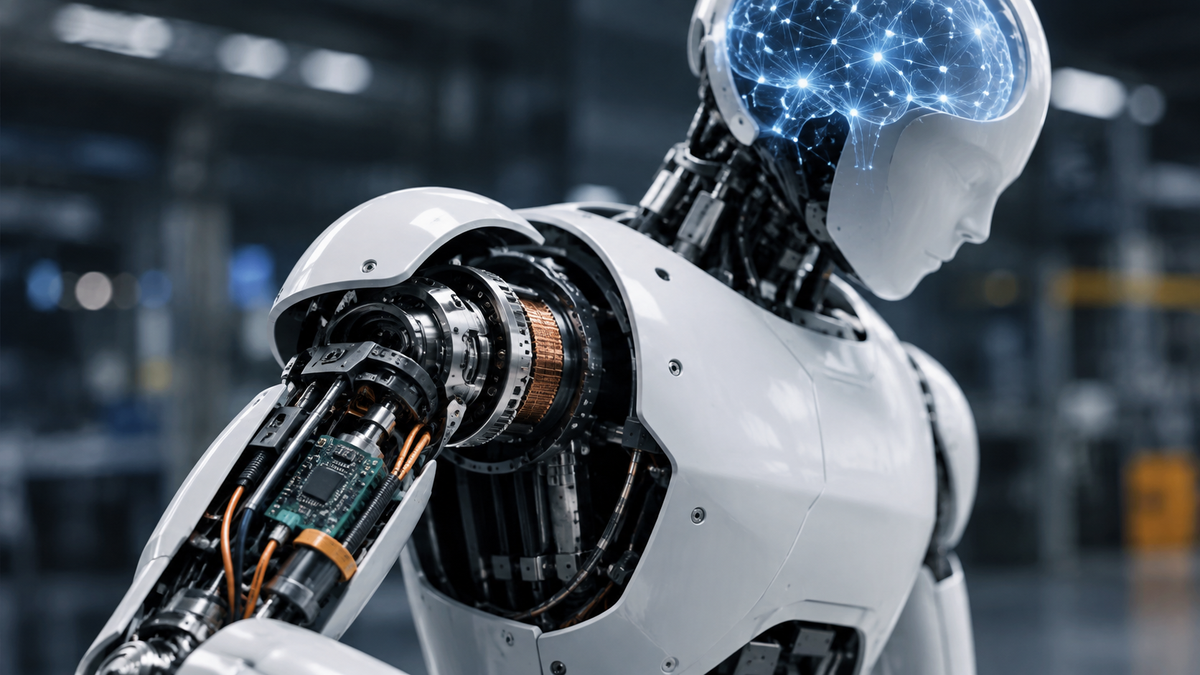
Intelligence is improving fast. The machines that turn that intelligence into physical action face a very different set of constraints.
AI is improving at an extraordinary pace. Models can see, reason, plan, write code, use tools, and increasingly take actions on our behalf.
It's tempting to project that curve directly onto robotics. If AI keeps getting smarter, shouldn't robots quickly become smarter, stronger, and more useful too?
I don't think it's that simple.
Intelligence is only one layer of a physical system.
A robot can know exactly what it needs to do and still be physically incapable of doing it.
1. Knowing how to lift is not the same as being able to lift
Imagine a humanoid robot standing in front of a heavy box.
Its cameras recognize the object. The AI understands the task, finds a good grip, plans the motion, and calculates how to maintain balance.
The reasoning could be perfect.
But eventually something has to generate torque at the joints and actually lift the box.
That means motors, transmissions, bearings, motor drivers, structures, cooling, and energy all have to work together.
Figure 1 — A robot joint is a system
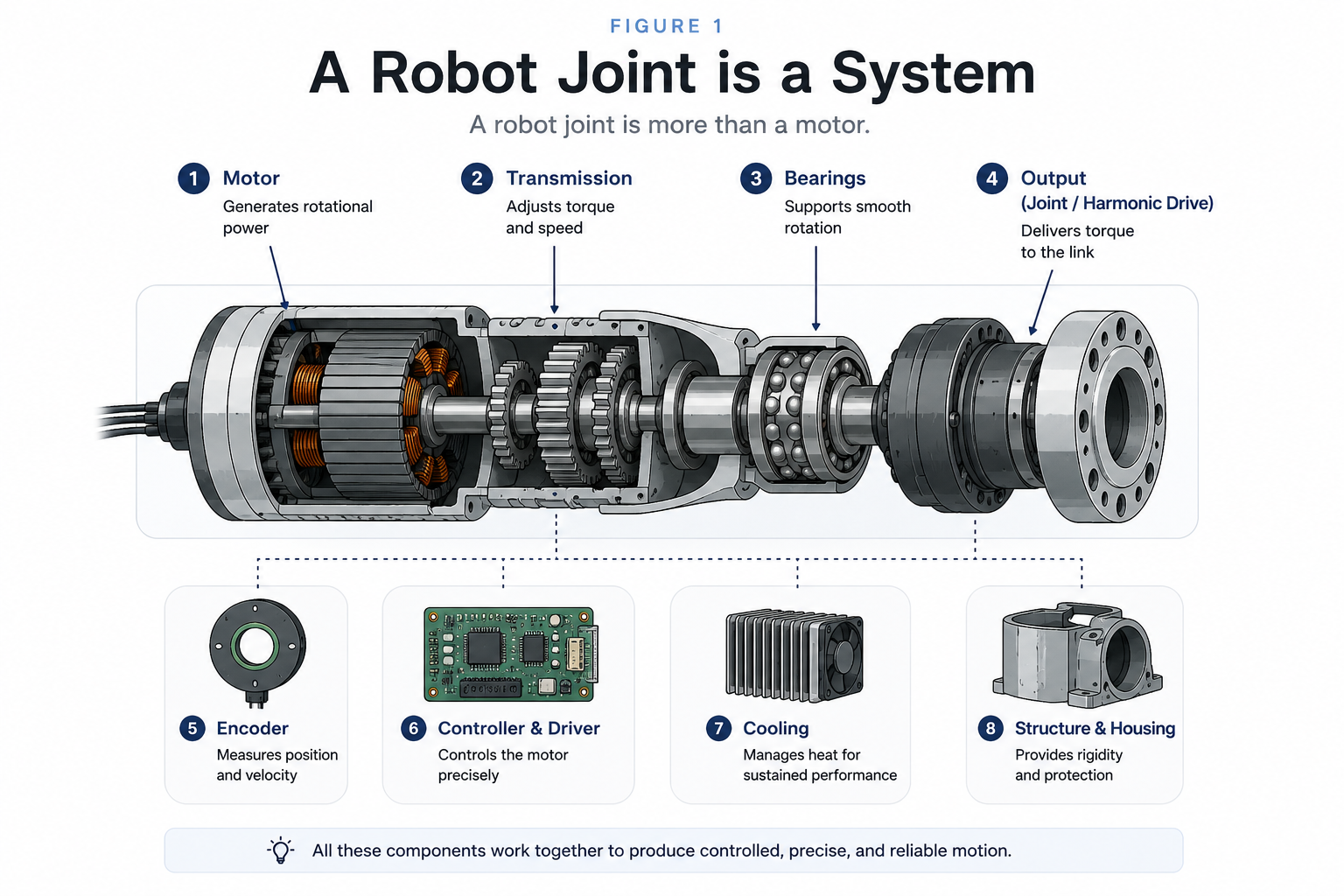
A simplified representation of a typical electromechanical robotic actuator.
This is where physical constraints start to compound. More torque may require a larger motor or more gearing. More gearing can affect speed, bandwidth, efficiency, backdrivability, and physical interaction. More power creates heat, while cooling adds weight and complexity.
Humanoid hardware research has dealt with these trade-offs for years. Reviews of bipedal humanoid design describe actuation not as an isolated component problem, but as something deeply connected to mechanical structure, compliance, sensing, efficiency, and locomotion.[1]
Recent research attempting to define "human-level actuation" makes a similar point. Peak torque or speed alone isn't enough to describe whether a humanoid joint is actually human-like. Torque and power must be available together under useful operating conditions, while range of motion, efficiency, bandwidth, and thermal sustainability also matter.[2]
So the useful question isn't:
How strong is the motor?
It's closer to:
Can the system deliver enough force, at the right speed, for long enough, while remaining light, efficient, controllable, and safe?
That's a much harder problem.
2. Strength is a system-level trade-off
This is why I don't think Physical AI is simply waiting for "stronger motors."
Electric motors can already produce impressive power and precision. But robots don't need peak performance in isolation. They need power together with low weight, controllability, compliance, efficiency, durability, and safety.
Research into artificial muscles makes this trade-off especially visible. Traditional rigid actuators are powerful and precise, while newer soft and fiber-based approaches explore different combinations of flexibility, weight, adaptability, and actuation performance.[3] There is no single metric that captures what makes an actuator useful for a robot.
Figure 2 — The actuation trade-off
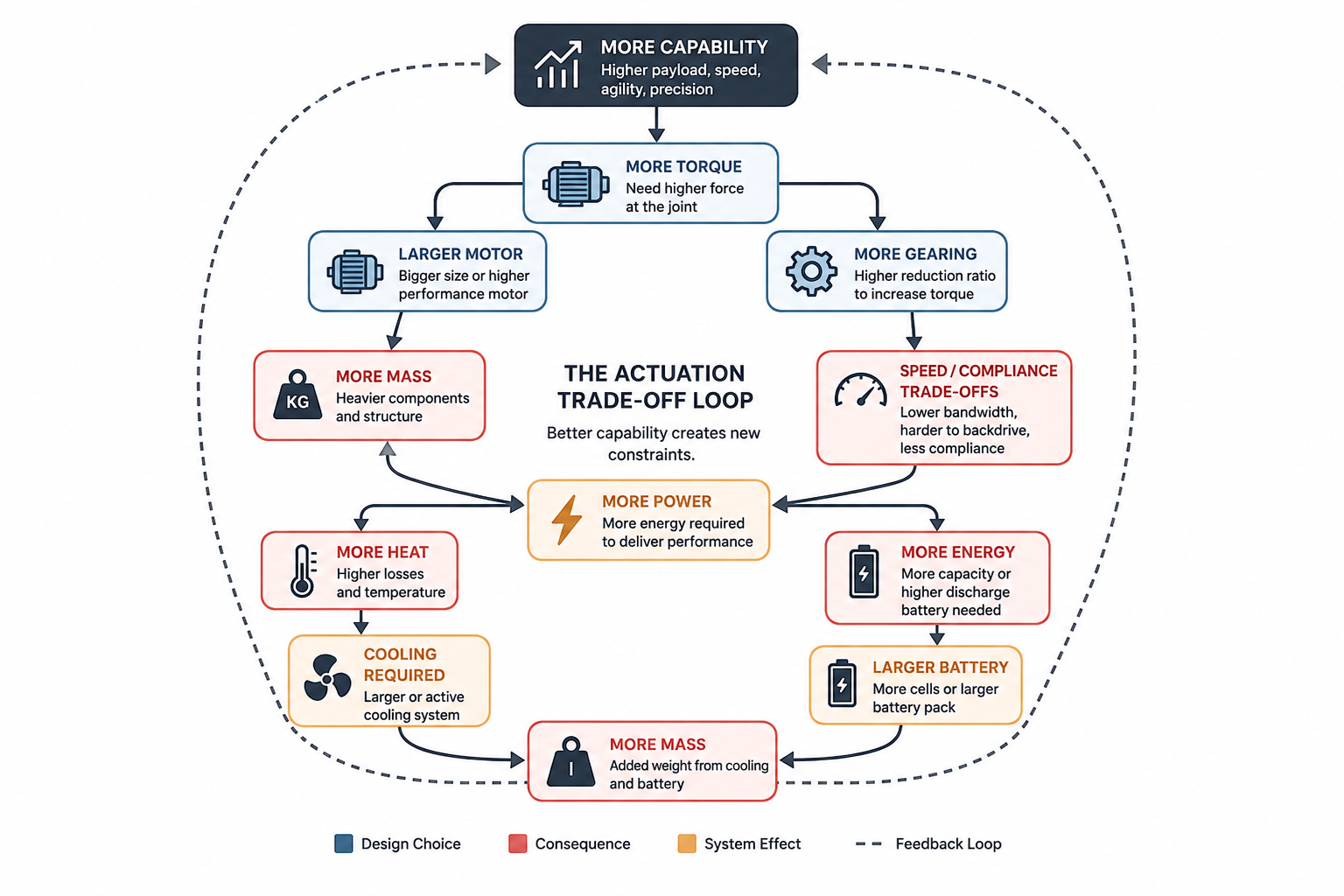
Conceptual illustration of system-level actuator trade-offs.
And then there is energy.
If we make a robot more powerful, those actuators need more energy. A larger battery provides more energy, but also adds mass. That additional mass has to be moved, accelerated, balanced, and supported by the same actuators.
The loop becomes:
More capability → More power → More energy → More battery → More weight → More required capability
This is fundamentally different from software. Adding more compute doesn't make the software itself physically heavier.
A robot doesn't get that luxury.
Recent reviews of humanoid deployment continue to identify payload, energy efficiency, battery endurance, mechanical robustness, perception, and safety as intertwined barriers to practical use.[4][5]
That's why I think sustained capability matters more than peak capability.
A robot performing an impressive task once is different from a robot doing useful work reliably for hours.
3. Physical AI is a stack
The more I look at Physical AI, the less useful it feels to talk about "AI" as though it were the whole system.
Intelligence has to pass through multiple layers before anything happens in reality.
Figure 3 — The Physical AI Stack
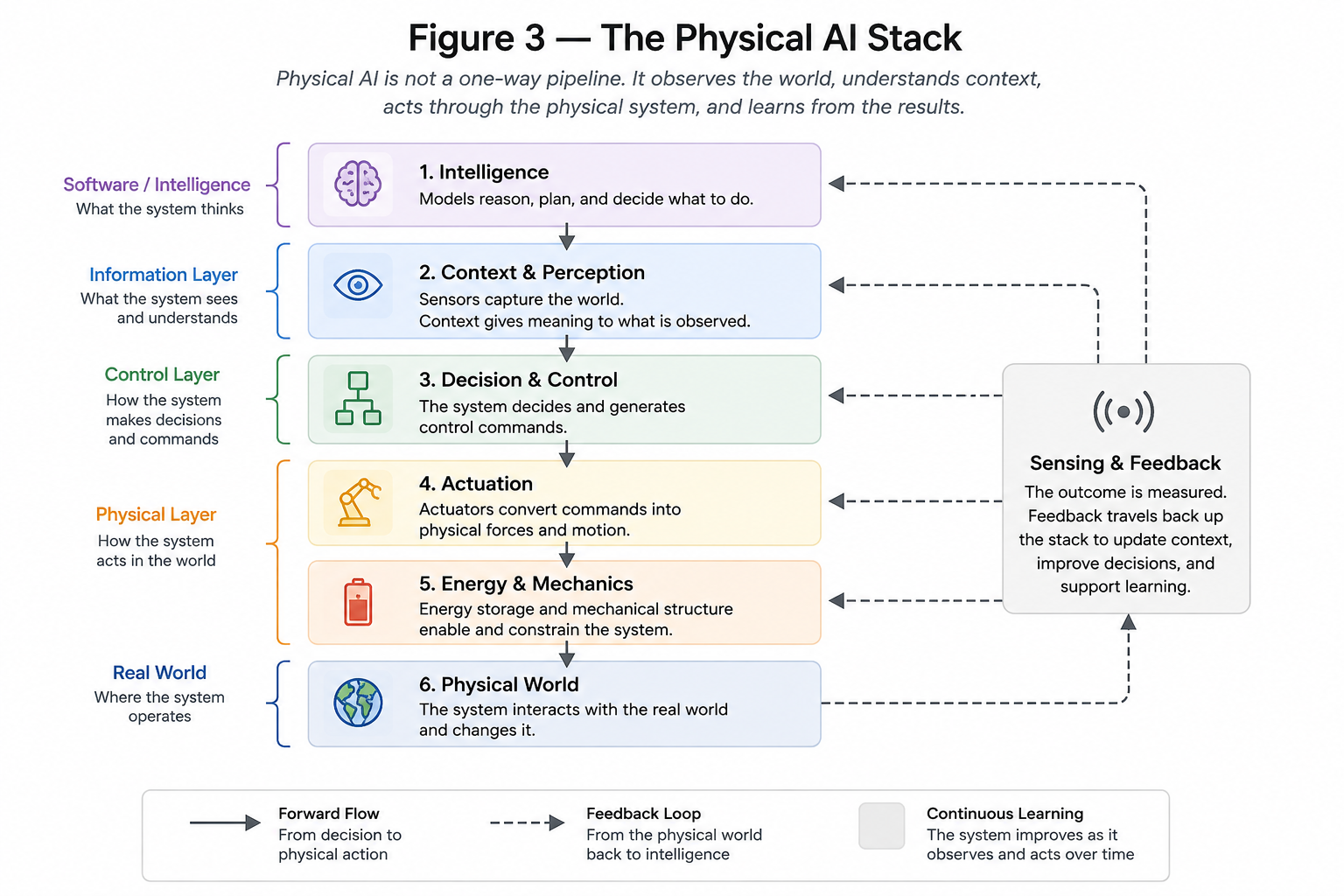
Physical AI is not a one-way pipeline. The system has to observe the world, understand its context, act on it, and learn from what happens next.
This is why I think of Physical AI as a stack rather than a model.
A capable model may improve the intelligence layer dramatically, but every decision still has to travel through perception, control, actuators, energy, and mechanics before it becomes physical action. Then the result has to come back through sensing and feedback.
The problem is that these layers don't necessarily improve at the same speed.
AI models can change dramatically within months. Physical systems usually can't.
A better actuator may require new electromagnetic designs, transmissions, materials, thermal systems, manufacturing processes, reliability testing, and supply chains. Batteries depend on electrochemistry. Tactile sensing involves materials, electronics, packaging, and manufacturing. Mechanical structures still have to deal with friction, fatigue, impact, tolerances, and wear.
You can't solve all of those problems by adding more tokens or compute.
This creates an interesting possibility:
The intelligence of robots may improve faster than their physical capability.
A robot may understand what we want long before it can perform the task economically, safely, reliably, and continuously.
4. I've seen a smaller version of this before
I've worked with industrial sensors and predictive maintenance systems, and the scale was very different from humanoid robotics. But I encountered a similar lesson.
A better anomaly detection model didn't fix a sensor installed in the wrong place. A better sensor didn't fix unreliable communication. Reliable communication didn't solve security restrictions. Good data didn't automatically provide operating context. And even an accurate alert created little value if nobody acted on it.
Eventually, I stopped thinking about the model as the product.
The product was the loop:
Sense → Understand → Decide → Act → Learn
Physical AI extends that loop in an important way.
With software, "Act" might mean sending a message, updating a database, or calling an API.
With Physical AI, Act means changing something in reality.
And reality pushes back.
That is why I think some of the most important questions in Physical AI may sit outside the model:
- Can the machine observe the world reliably?
- Does it have enough context to understand what it observes?
- Can it physically perform the required action?
- Can it sustain that action safely and economically?
- Can it observe the result and learn from what happened?
These aren't secondary implementation details.
They are prerequisites.
AI is removing one bottleneck incredibly quickly: intelligence.
As that bottleneck disappears, the others may simply become more visible.
Some will be software problems. Some will be data problems. Some will be product problems.
And some will be governed by physics.
Physical AI will advance at the speed of its slowest critical layer — not simply at the speed of AI.
References
[1] Ficht, G. & Behnke, S. (2021). Bipedal Humanoid Hardware Design: a Technology Review. Current Robotics Reports.
https://doi.org/10.1007/s43154-021-00050-9
[2] Sunbeam, M. N. (2025). Human-Level Actuation for Humanoids. arXiv.
https://arxiv.org/abs/2511.06796
[3] Moon, J. H. et al. (2025). Fiber-type artificial muscles for robotic actuation. npj Robotics.
https://doi.org/10.1038/s44182-025-00059-8
[4] Uthai, T. et al. (2026). Opportunities, challenges and roadmap for humanoid robots in construction. Scientific Reports.
https://doi.org/10.1038/s41598-025-30252-6
[5] Huang, J., Gao, J. & Yu, Z. (2026). Orchestrating mechanics, perception and control: Enabling embodied intelligence in humanoid robots. Information Processing & Management.
https://doi.org/10.1016/j.ipm.2025.104363